
Experience that Drives the Business.
TECHNOLOGY
Experience & AI
Across industries, organisations report persistent gaps between digital presence and digital usefulness: fragmented journeys, delayed responses, duplicated work, and teams compensating manually for system limitations. These gaps translate directly into slower conversion, higher service cost, and operational friction.
Experience that Drives the Business
Analysis
Team Digtrix
Inputs
By Naayaab Zakir [CTO & Managing Partner Digtrix]
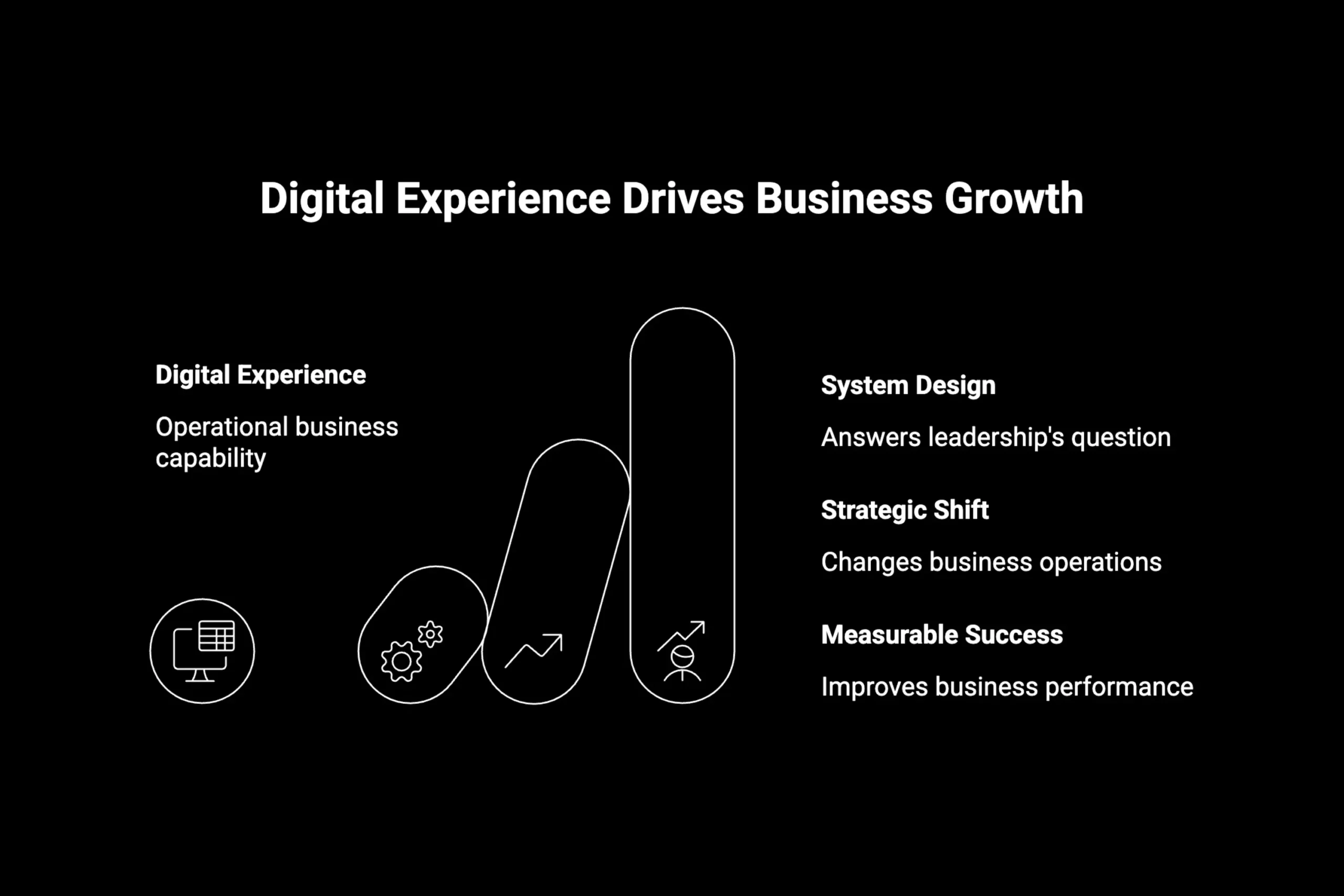
Experience matters. Not as a slogan, but as a dependable capability that a business can operate, measure, and improve over time. Today’s organisations juggle platforms – commerce engines, CMSs, CRMs, support services, analytics, and increasingly AI services – each promising outcomes in isolation.
The real question for leadership is simpler and more consequential: which capabilities reliably move the business forward, quarter after quarter?
We design systems that answer that question. We treat digital experience as an operational capability, not a marketing channel. That shift changes what you build, what you buy, and how you measure success.
.
Why now
Digital access is no longer the constraint. Connectivity, devices, bandwidth, and cloud infrastructure are broadly available across markets. Most enterprises already operate multiple digital touchpoints across web, mobile, partner portals, and internal tools, often as part of broader digital transformation initiatives.
Yet performance remains uneven.
Across industries, organisations report persistent gaps between digital presence and digital usefulness: fragmented journeys, delayed responses, duplicated work, and teams compensating manually for system limitations. These gaps translate directly into slower conversion, higher service cost, and operational friction.
The difference between a visible website and a dependable platform is not technology alone. It is how systems combine to deliver predictable business outcomes – conversion, retention, time-to-resolution, fulfillment accuracy, and cost efficiency.
Digital access – the ability for customers, partners, and employees to interact reliably across channels – is the foundation. Without it, personalization, automation, and analytics remain local optimisations with limited reach. With it, those same technologies become levered capabilities, compounding value across the organisation.
The shift – from tools to platforms
The old approach stacks tools.
A marketing team adds plugins to increase engagement.
A product team launches a microsite to ship faster.
Support introduces a chatbot to deflect tickets.
Each decision solves a narrow problem. Over time, this mirrors the limitations of traditional marketing strategies applied to modern systems.Each adds another integration, another dependency, another reconciliation task. Over time, complexity grows faster than value.
The modern approach starts differently. It asks: which decisions must the business make more reliably and at scale?
- Which leads should be prioritised now – not later?
- Which customer issues require immediate escalation?
- Which content, offer, or action improves outcomes in this moment?
From that decision, platforms are designed.
Systems are selected for the signals they expose and the actions they enable. Data is governed so it can be reused safely across teams. Intelligence is embedded as services that assist human decisions, rather than isolated features that optimise one metric in isolation.
The result is a shift from fragmented to connected, from reactive to intentional.
The real problem – why most initiatives stall
Across industries, stalled CX and platform initiatives tend to share three interlocking issues.
Access without capability
Many organisations launch digital experiences that are technically live but operationally thin. Content, commerce, customer data, and support systems remain disconnected. Teams lack shared context, personalization degrades, and staff revert to manual workarounds to close gaps.
Widgetised AI
AI adoption often begins at the edges – chat widgets, recommendation snippets, copilots layered onto existing flows, reflecting how AI and automation are frequently deployed tactically. These improve isolated metrics but rarely change how work gets done. Without workflow integration and ownership, AI increases surface complexity without reducing cost or increasing scale. Intelligence must live where decisions are made, not beside them.
Fragile integrations and governance gaps
Point-to-point scripts and unmanaged plugins create hidden technical debt. When integrations fail, recovery depends on human intervention. Worse, data ownership is unclear, SLAs are undefined, and rollback paths are undocumented. Reliability becomes a hero exercise instead of a system property.
These are not technology problems alone. They are organisational design problems. Solving them requires product discipline, operational ownership, and governance – not one more tool.
How we think about it – a practical posture
We design systems that align people, data, and technology around outcomes. The principles are practical and repeatable.
Start with the decision
Identify the one or two decisions that generate disproportionate value when improved. Use those decisions as the design lens for interfaces, integrations, and data flows. Examples include offer selection, ticket prioritisation, fraud routing, or fulfillment exceptions.
Treat components as replaceable services
Platforms should tolerate change. Components are selected or built with clear contracts, versioning, and ownership. This reduces long-term risk and lowers the cost of evolution.
Embed intelligence as a service
AI is most effective when it ranks, predicts, or routes within live workflows. Decision services should be measurable, explainable, and continuously improved using production signals.
Design for ownership and governance
Data domains require accountable owners. Contracts, SLAs, and quality thresholds are defined explicitly. Governance becomes operational – enabling trust in the signals teams use daily.
Make integration observable
Latency, failure rates, and data drift are monitored continuously. Observability transforms incidents from surprises into managed events – and turns improvement into a routine practice.
These patterns keep systems human-centered and enterprise-ready. They push decisions closer to the point of impact while keeping platforms operable under scale.
What we build – concrete system patterns
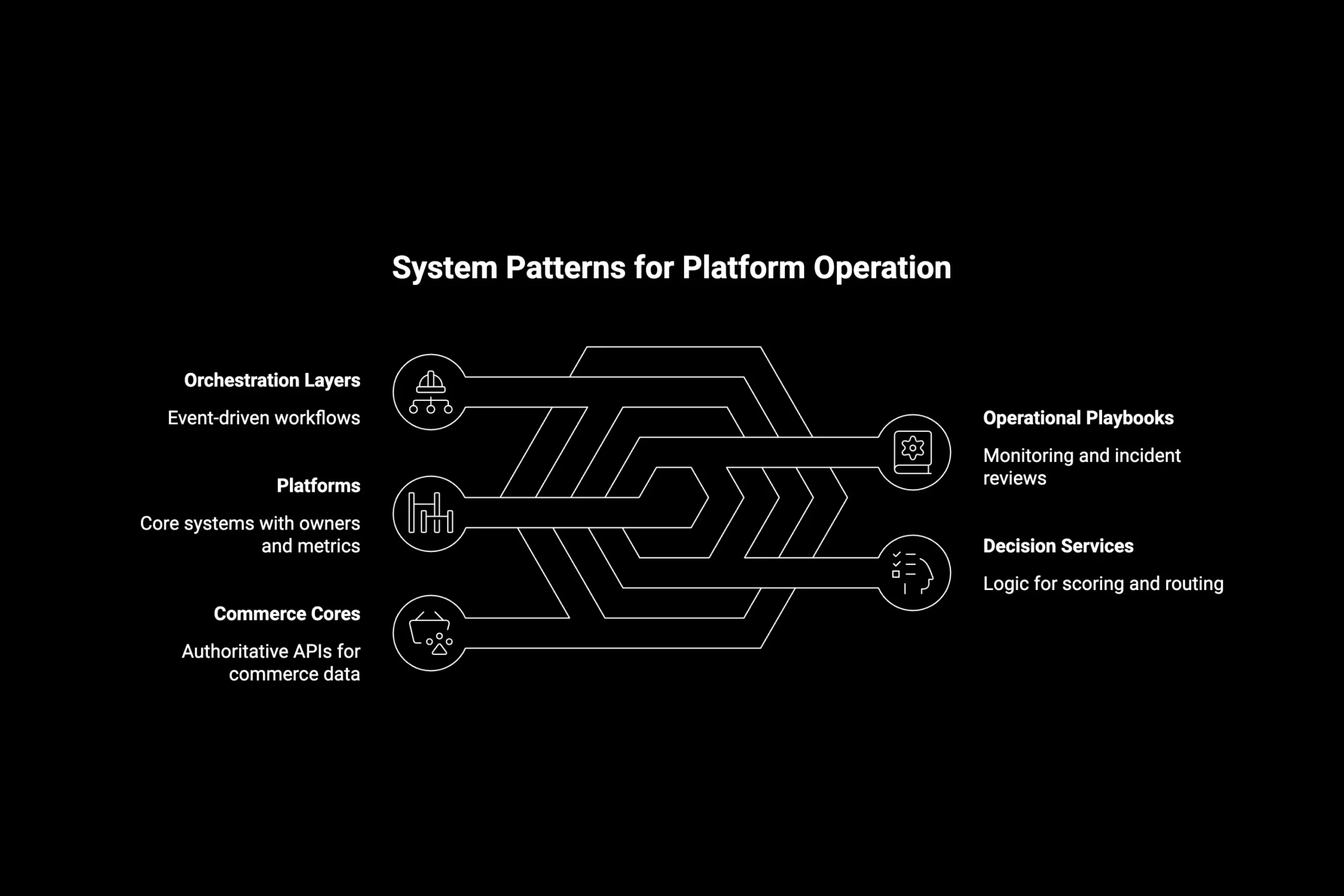
From strategy to execution, several system patterns consistently convert intent into capability.
Content as structured data
Headless and composable content models enable reuse across channels and teams. This reduces duplication, accelerates localisation, and supports consistent personalization.
Commerce cores with authoritative APIs
Orders, pricing, and catalog data must have a single source of truth. Clean API layers ensure merchandising, fulfillment, finance, and experience teams act on the same facts.
Orchestration layers
Event-driven workflows decouple systems and improve resilience. They allow teams to test changes safely and respond to business events in near real time.
Decision services
Scoring, prioritisation, and routing logic lives in services with clear interfaces and SLAs. Performance is tracked, audited, and refined continuously.
Operational playbooks
Every integration and service includes monitoring, runbooks, and incident reviews. Outages become learning loops, not recurring surprises.
We build platforms that operate — with owners, metrics, and the ability to improve.
What this enables – measurable outcomes
When experience becomes a platform capability, organisations see tangible effects:
- Faster, clearer decisions driven by shared signals rather than reconciled reports
- Consistent journeys across content, commerce, and support, grounded in shared data
- Lower operational risk through observable integrations and defined ownership
- Incremental scale without replatforming, enabling continuous evolution
- Sustained AI value, with models improving through embedded feedback loops
These are not vanity metrics. They influence revenue velocity, cost structure, and resilience.
Why it matters – the business case
Boards and CXOs ultimately care about three things: delivery speed, operational reliability, and measurable impact.
Platforms built with discipline shorten time-to-market, reduce firefighting, and convert AI and automation from pilots into durable returns. Tactical wins – a faster chatbot response or a short-term campaign lift – matter. But strategic advantage comes from reducing friction across lead-to-cash, service-to-resolution, and content-to-conversion journeys over time.
That is the difference between experimentation and capability.
Practical next steps – a concise roadmap
If your stack feels fragmented, start small and concrete:
- Map three critical decisions across the customer lifecycle
- Identify where the data for those decisions lives – and who owns it
- Choose one decision to industrialise with a decision service and SLAs
- Introduce observability for that flow and iterate based on evidence
- Assign owners and publish a simple governance charter
These steps create momentum. They turn digital effort into operational capability.
If your organisation needs a focused diagnostic, we run a short assessment that surfaces the most expensive structural gaps and returns a 30-day improvement roadmap. We design systems that move business forward – practically, measurably, and at enterprise scale.
Let's Talk
Our AI-first systems approach help organizations grow, adapt, and operate with confidence..