
Platforms built to think.
TECHNOLOGY
Artificial Intelligence
This Viewpoint explains how to think about platform decisions, where AI belongs, and how to turn brittle point solutions into predictable operational capability. It is written for leaders balancing governance, speed, and measurable outcomes — not marketing copy or vendor comparisons.
Read it as a short playbook: design intelligence into systems, not on top of them.
Platforms built to think
Analysis
Team Digtrix
Inputs
By Naayaab Zakir [CTO & Managing Partner Digtrix]
Technology choices no longer start and end with a feature checklist. For modern organisations, a website, commerce engine, or support bot is only useful when it operates as part of a wider system — one that serves people, teams, and decisions.
This distinction matters more now than ever. Almost every enterprise is already using AI in some form, yet only a minority are seeing meaningful, enterprise-level impact. The gap is not access to technology. It is the absence of platforms designed to absorb intelligence into real workflows.
Leaders must stop treating digital assets as channels and start treating them as capability platforms: systems that connect data, processes, and people so the business can act with speed and confidence.
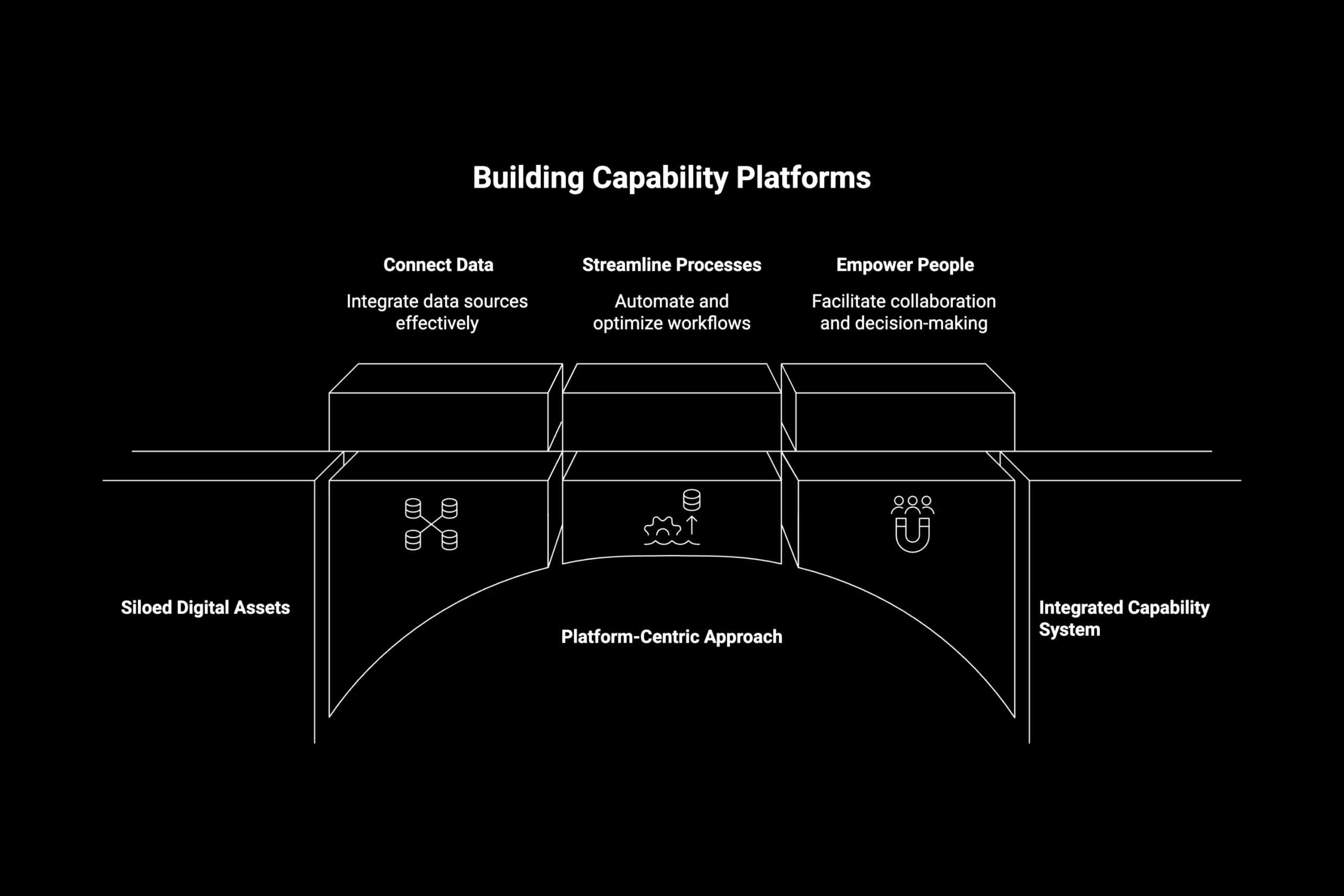
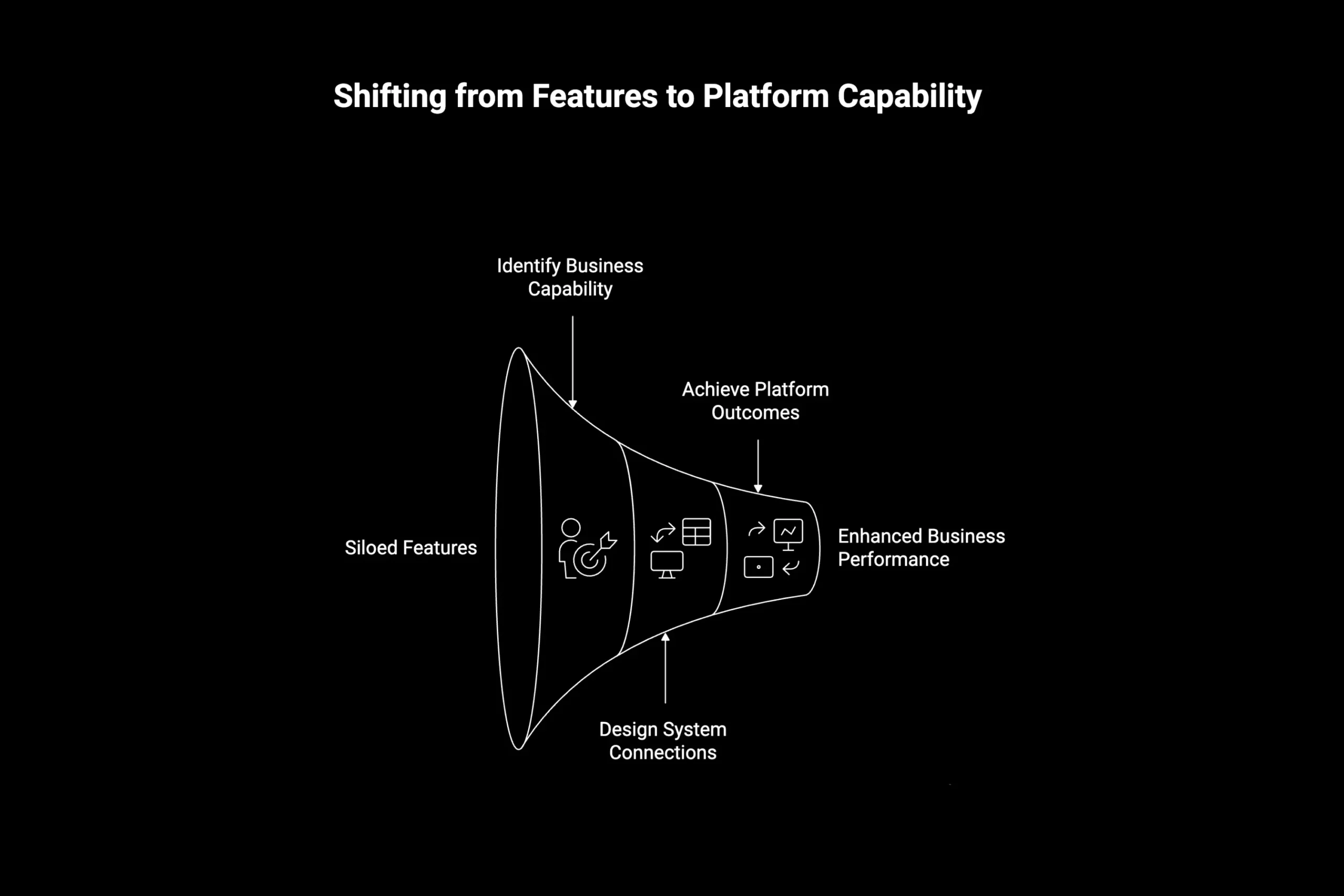
The shift — from siloed features to platform capability
For years, the natural instinct was to add.
A commerce plugin here.
A chatbot there.
A new layer promising personalization or automation.
This approach creates islands of capability. Each island solves a narrow problem but introduces hidden costs: duplicated data, inconsistent customer experiences, and fragile integrations that degrade as scale increases.
This pattern explains why so many AI initiatives stall. While AI adoption has become widespread across industries, most organizations remain stuck in experimentation or pilot phases. Intelligence exists — but it does not travel far enough through the system to change outcomes.
The new frame is simpler and more demanding:
What business capability are you trying to run?
Is the goal consistent merchandising across channels?
Faster customer resolution?
Predictable fulfillment?
Higher retention through informed, personalized journeys?
Once the capability is clear, platform choices become design decisions about how systems connect — not bets on individual features.
This is the move from product features → platform outcomes.
A platform earns its value by supporting decisions and workflows reliably, not by accumulating options in a menu.
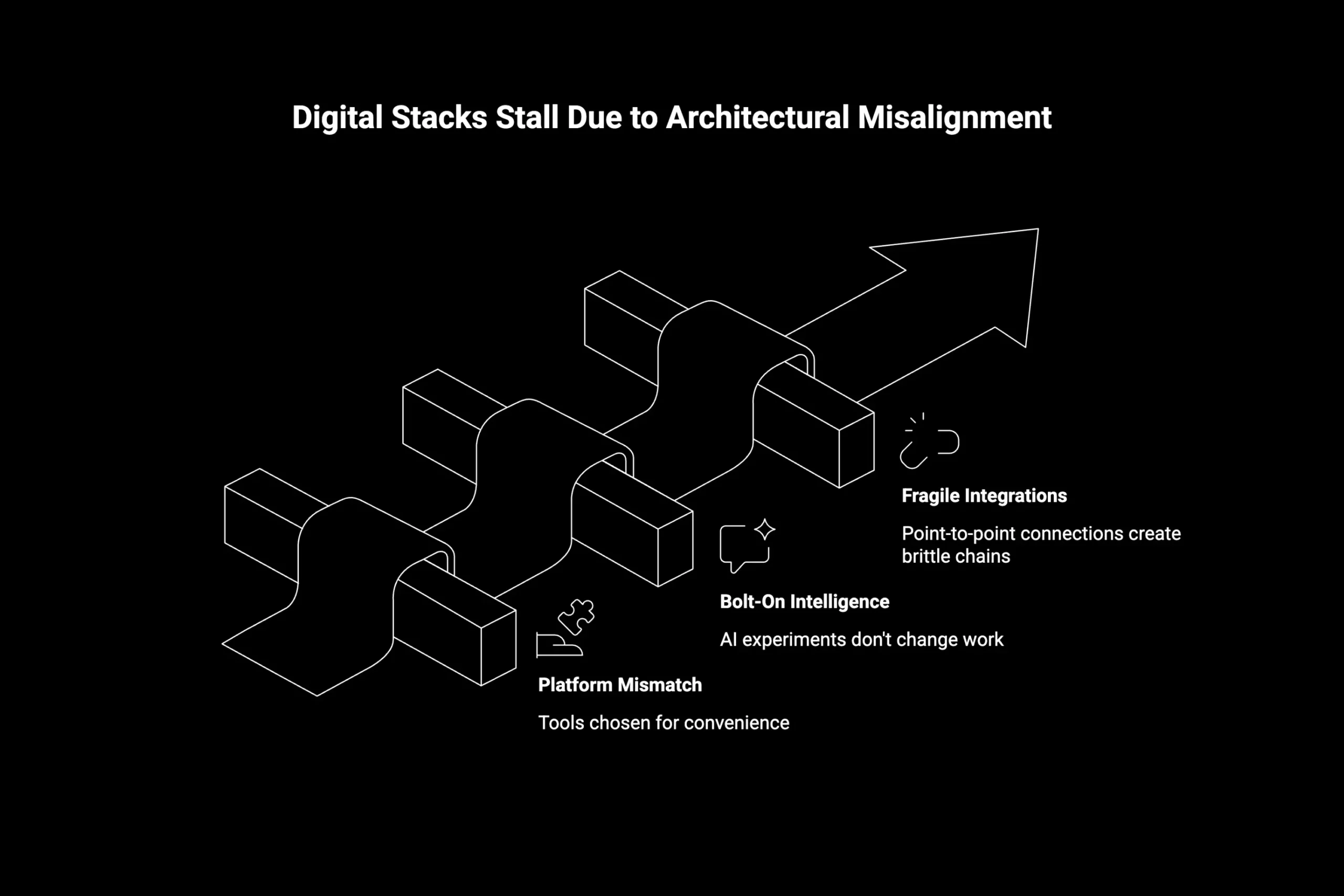
The real problem — why most digital stacks stall
Across industries, the same structural failure patterns appear:
1. Platform mismatch
Tools are selected for speed, familiarity, or short-term wins rather than long-term operability. What works in a pilot becomes fragile under governance, scale, and compliance. As organizations grow, the cost of retrofitting controls exceeds the original savings.
This is why larger enterprises, despite having more resources, often struggle more with fragmented stacks — the early decisions harden into constraints.
2. Bolt-on intelligence
AI is frequently deployed as an interface feature: a chatbot, a recommendation widget, a predictive badge. These experiments may improve local metrics but rarely redesign how work happens.
The organizations seeing sustained value from AI are doing something different. They redesign workflows so intelligence changes decisions — who acts, when they act, and with what confidence.
Without that redesign, AI improves visibility but not velocity.
3. Fragile integrations
Point-to-point integrations — scripts, plugins, sync jobs — form brittle chains. When one link fails, teams revert to manual reconciliation. Over time, operational drag becomes normalized.
The hidden cost is not outages.
It is slower decisions, lower trust in data, and constant firefighting.
Put simply: the problem is not technology scarcity.
It is architectural misalignment.
Organizations have tools.
They lack systems.
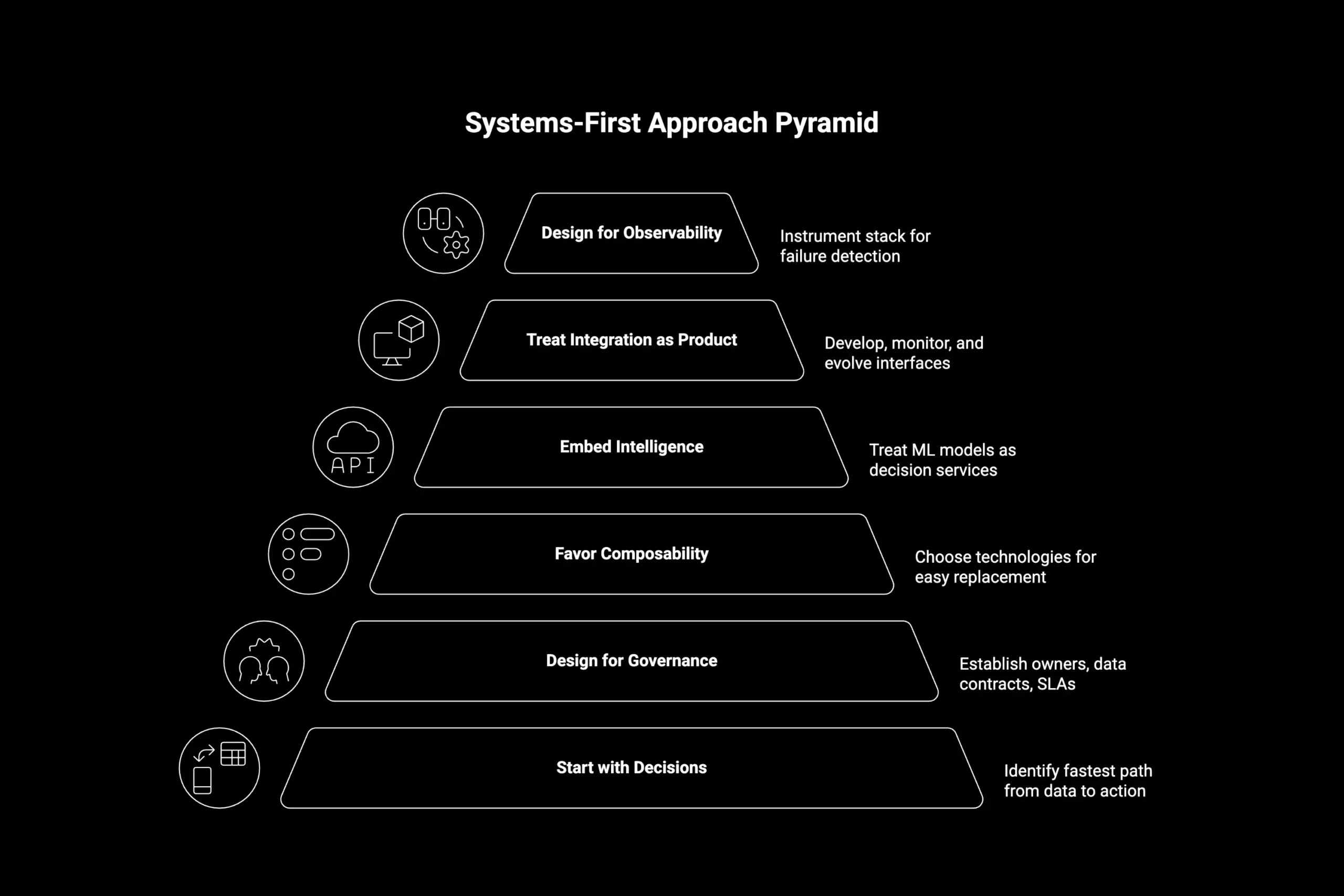
How we think about it — a systems-first approach
We design systems that align technology with the decisions people must take.
Our guiding principle is straightforward:
embed intelligence where it changes behavior and outcomes, not where it looks impressive.
That leads to a few non-negotiable design moves:
Start with decisions
Identify the decision that moves the most value when made faster or more reliably. Many organizations deploy AI broadly, but the highest-performing ones focus on a small number of critical decisions and scale from there.
The fastest path from data to action becomes the primary integration to design, govern, and measure.
Design for governance
As AI use expands, risk exposure expands with it. Inaccuracy, explainability, compliance, and reputation are now operational concerns — not theoretical ones.
A platform needs clear ownership, data contracts, and service-level expectations. Governance is not bureaucracy; it is the structure that allows teams to trust outputs and act without hesitation.
Favor composability
Composable platforms — headless CMS, modular commerce, orchestration layers — allow parts to evolve without destabilizing the whole. This matters because change is constant.
Organizations that scale intelligence successfully treat replacement as a feature, not a failure.
Embed intelligence as a decision service
Instead of UI-bound features, treat models as services:
- Rank support tickets
- Score leads
- Route orders
- Prioritize content or offers
This keeps AI measurable and accountable. It also allows intelligence to operate across channels, not inside them.
Treat integration as a product
Integration deserves design, testing, monitoring, and ownership. It should be observable, resilient, and continuously improved.
When integration is treated as an afterthought, intelligence never compounds.
Design for observability
High-performing organizations instrument their platforms to see where decisions stall, where latency appears, and where data diverges. This visibility turns AI from a black box into an operational asset.
This is not theoretical.
It is a repeatable posture: design, build, measure, iterate.
The system is the product.
What we build — concrete patterns that work
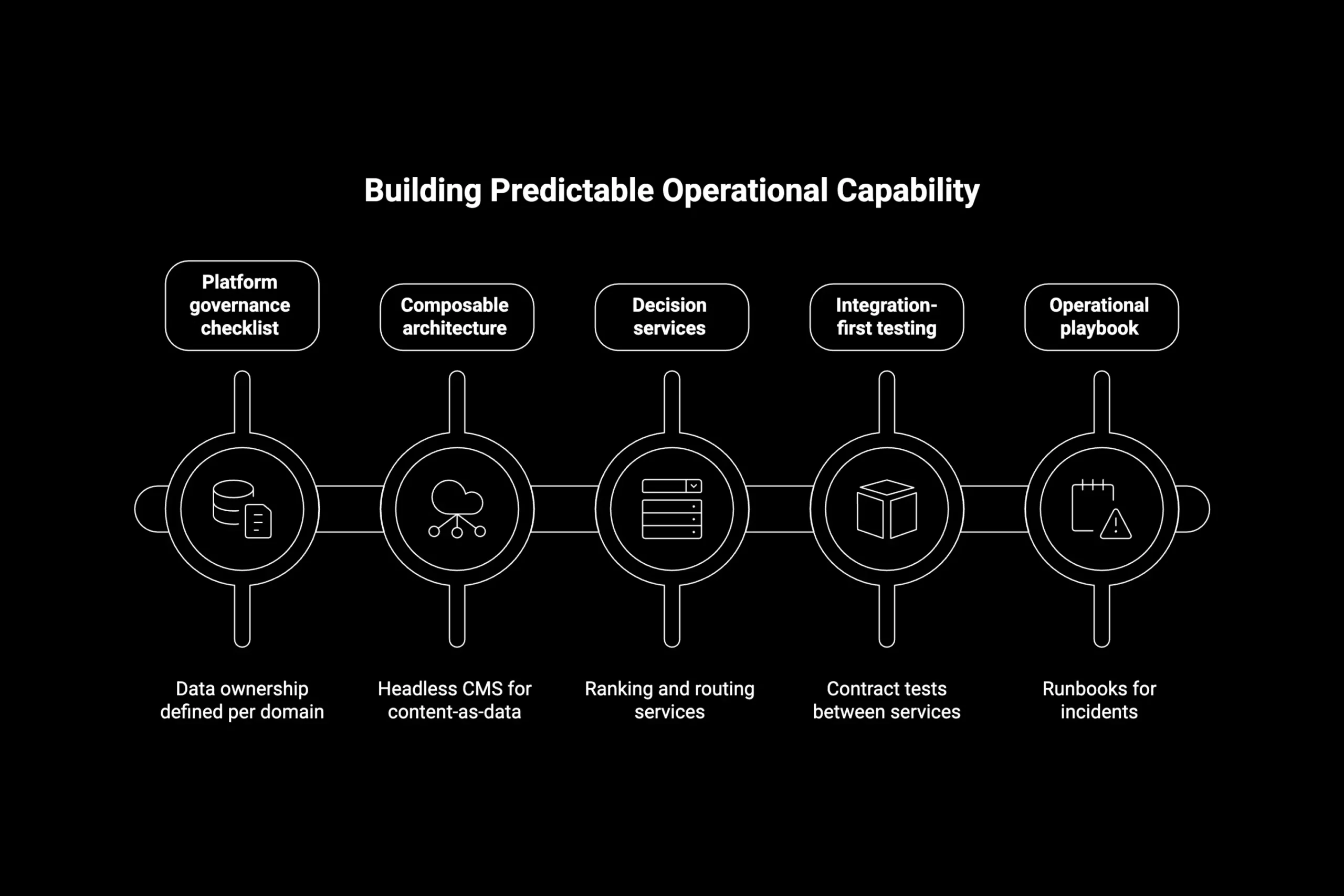
To operationalize this approach, a small set of patterns consistently outperform feature-driven stacks:
Platform governance checklist
- Clear data ownership by domain
- Explicit data contracts (schema, cadence, error handling)
- Defined SLAs for services and teams
Composable architecture
- Headless CMS for content as structured data
- Commerce core with stable APIs for pricing, inventory, and orders
- Orchestration layer to connect systems without tight coupling
- Analytics backbone that normalizes signals for operational decisions
Decision services
- Ranking and routing services for support, sales, and operations
- Personalization services that return constrained, ranked choices
- Insights APIs that serve consistent signals across teams
Integration-first testing
- Contract testing between services
- Synthetic traffic to validate flows
- Monitoring for latency, error rates, and data drift
Operational playbook
- Incident runbooks
- Post-incident reviews tied to product changes
- A roadmap for gradual replacement of legacy components
These patterns prioritize predictable operation over novelty.
They make scaling intelligence safer — and outcomes repeatable.
What this enables — outcomes you can measure
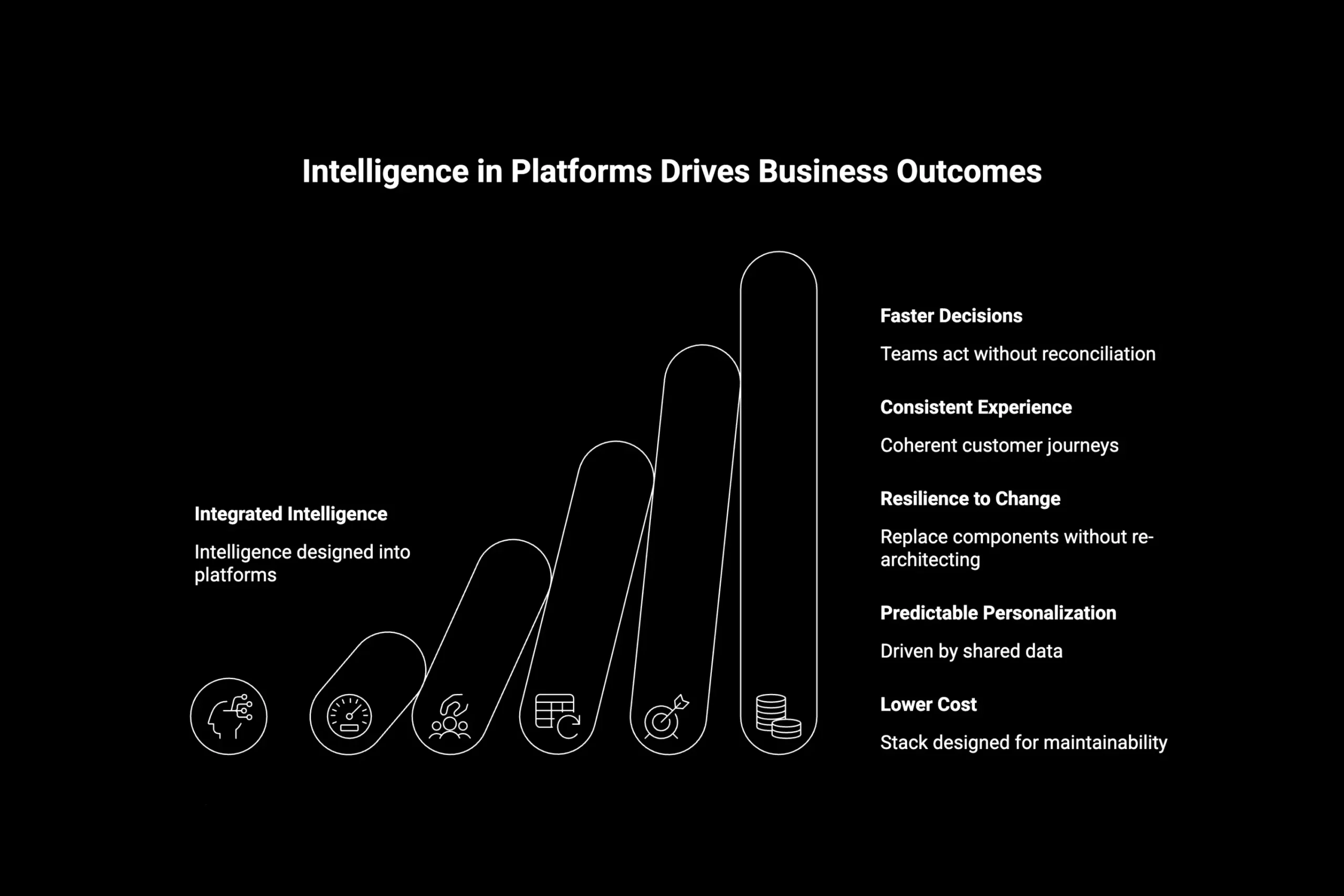
When intelligence is designed into platforms, organizations unlock capabilities that compound over time:
- Faster, clearer decisions
Teams act on shared signals instead of reconciling conflicting dashboards. - Consistent customer experience
Journeys remain coherent because content, commerce, and support draw from the same data and policies. - Resilience to change
Components evolve independently without enterprise-wide disruption. - Predictable personalization
Personalization becomes a capability when it’s measured against retention, conversion, and efficiency — not experimentation volume. - Lower total cost of ownership
Fewer firefights, clearer ownership, and modular upgrades reduce operational drag.
These are not aspirational benefits.
They are operational effects.
Why it matters — the business payoff
Intelligent technology solutions matter only when they make the organization easier to run.
That shows up in three board-level outcomes:
- Reduced time-to-market
Governed, composable platforms launch faster with fewer surprises. - Lower operational risk
Observable integrations and ownership reduce incident frequency and recovery cost. - Sustained value from AI
When AI is embedded in workflows, value compounds as models learn from real operational feedback.
This is how technology shifts from cost center to capability.
Practical next steps — a short roadmap for leaders
If your stack feels brittle or your AI initiatives fail to move the business, start here:
- Map 3–5 critical decisions across the customer lifecycle
- Audit where data lives, who owns it, and how it flows
- Industrialize one high-impact integration
- Replace UI-only AI with a decision service
- Introduce governance minimums before scaling
The goal is not replatforming overnight.
It is building confidence in a system that scales.
This perspective reflects patterns observed across large-scale enterprise AI and platform transformations globally.
Start the conversation.
If your teams are managing many tools but few systems, you don’t need more features — you need alignment.
We design platforms where intelligence, operations, and experience reinforce each other. If you want a short diagnostic — three questions that expose the most expensive structural gaps — we can run it with your team and return a concise roadmap.
Let's Talk
Our AI-first systems help organizations grow, adapt, and operate with confidence..